You Can Own Every Ounce and Still Not Own What It's Worth.


For fifty years, sovereignty meant owning what's beneath the soil. That definition is no longer complete and the gap is showing up on balance sheets before it shows up in policy.
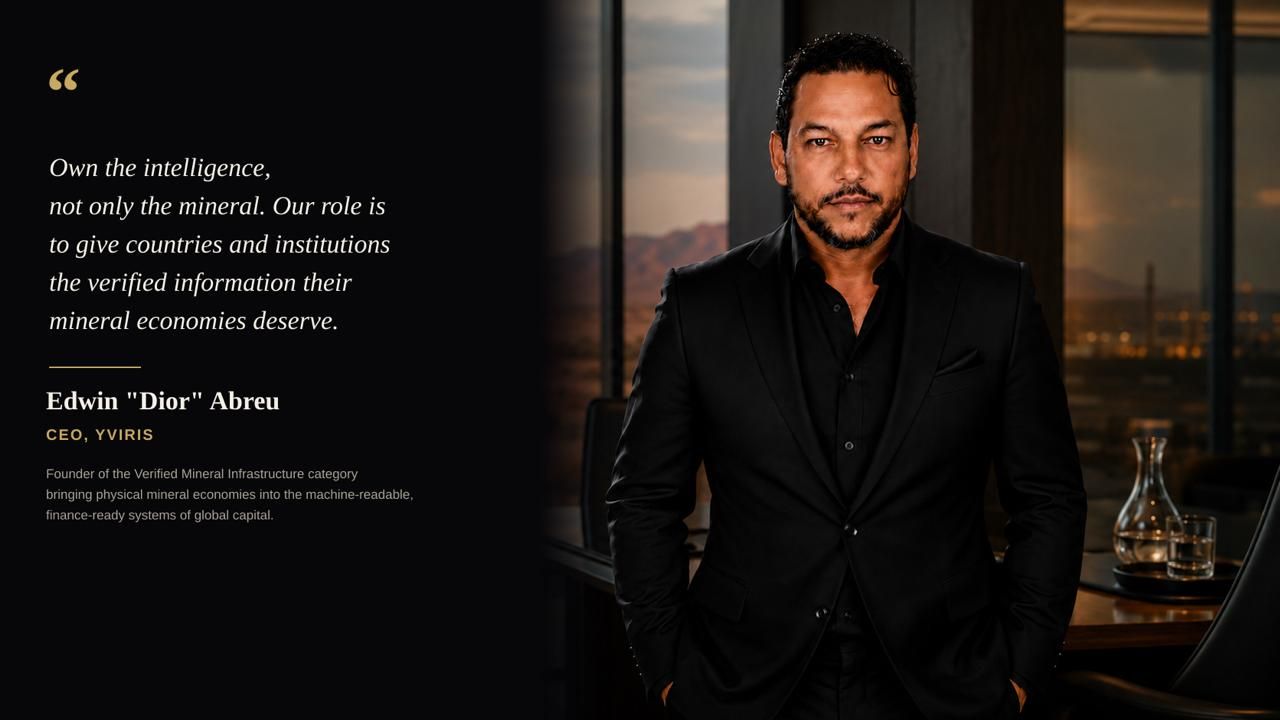
By Edwin Dior Abreu, CEO of YVIRIS
Owning the mineral was never the whole deal.
It just used to be enough to look like the whole deal.
Own the intelligence, not only the mineral. That's the argument I intend to make everywhere YVIRIS goes, and it starts from a fact most producing governments haven't had to confront yet: someone else can control what your minerals are worth without ever touching the ground they came from.
Two Shipments. One Country. Different Outcomes.
Two consignments of the same ore leave the same mine, six months apart.
The first has a documented assay, a clean custody record, and a transaction history a bank can check in an afternoon. It clears financing fast, at a competitive rate.
The second is chemically identical. But the paperwork is thinner, the custody chain has a gap, and no institution has financed anything like it before. It sits longer. It costs more. Sometimes it doesn't move at all.
Same country. Same soil. Same royalties paid.
Two completely different financial outcomes decided entirely by information the mine itself didn't control.
Traceability Was Never the Finish Line
Here's where most of this conversation stalls.
Everyone agrees traceability matters. Governments fund it. Refiners demand it. Certification bodies build entire frameworks around it.
Traceability isn't wrong. It's incomplete.
Traceability that stops at a compliance report is a cost. Traceability that reaches a bank, an insurer, or a collateral desk is infrastructure.
Most producing countries have built the first kind. Almost none have built the second. The information exists the assay, the custody transfer, the processing event, the settlement but it dead-ends in a filing cabinet instead of becoming something a financial institution can act on.
That's the gap. Not a lack of data. A lack of a system that turns verified data into financial capability.
The Evidence Is Already on the Calendar
This isn't a forecast. Three things are already locked in.
Starting in 2027, LBMA requires monthly, mandatory country-of-origin reporting from every Good Delivery refiner not optional, not someday.
The OECD's own 2025 review of mineral traceability systems reached a blunt conclusion: traceability only has value if it's built toward a defined financial objective, not as an end in itself.
And the World Gold Council is already building shared infrastructure Gold as a Service to connect physical custody directly to digital issuance and liquidity, the same institutions that used to treat the physical and financial sides of gold as separate businesses.
Three different institutions. Three different motives. One direction: physical assets are being rebuilt to be machine-readable, whether or not the countries producing them are in the room.
What This Actually Costs a Country
Run the framework forward and the shape is simple:
Physical Event → Verified Record → Trusted History → Financial Capability.
Most producing economies have built the first two steps and stopped. The custody chain exists. The assay exists. What doesn't exist is the layer that lets a bank price risk faster because of it, or lets an insurer underwrite with less friction because of it.
That missing layer has a cost, and it's not abstract. It's the spread between what the first shipment cleared at and what the second one didn't.
By 2030, that spread will be wider, not narrower. Financial infrastructure is getting more automated every year collateral systems, underwriting models, and increasingly AI-driven decisions all need structured, verifiable information to act on. A country that hasn't built the layer connecting its physical activity to that system isn't neutral in this shift. It's falling behind it.
Don't export the mineral and import the intelligence.
That's the mistake sitting in front of every producing government still measuring success in tonnage shipped rather than information built.
This Is the Layer YVIRIS Is Building
At YVIRIS, we call this layer Verified Mineral Infrastructure.
The premise is direct: every assay, every custody transfer, every processing event, every transaction should generate trusted economic intelligence governed by the country and the producer who created it, usable by the institutions that need it.
We don't decide what gets financed. Banks keep that decision, on their own terms, same as always.
What changes is what they're deciding with. A country that's built this layer walks into that conversation holding its own evidence. A country that hasn't is still waiting to be told what its own minerals are worth trusting.
Own the intelligence, not only the mineral.
For fifty years, the question was how much of the physical value chain a country could hold onto. Before 2030, every serious mineral-producing government will have to answer a harder one:
Who owns the financial identity of what you've already got out of the ground?